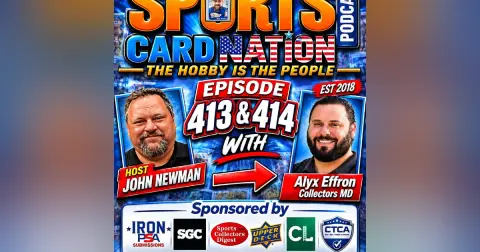
Alyx Effron returns! E414

 Apple Podcasts

 Spotify

 RSS Feed

 PocketCasts

 Overcast

 Castro
Collectors MD's Alyx Effron returns this week and we tackle many hobby topics and issues.
TALKING POINTS:
*Hobby Role
*Other Addictions parallel to Hobby ones
*Types of Hobby addictions
*Solutions
*CTCA Thoughts
*Hobby Regulation: Needed or no?
*Pet peeves and encouraging hobby things
Follow us on Social Media:
Website:
https://www.sportscardnationpodcast.com
https://linktr.ee/Sportscardnation
Merch shop:
https://sports-card-nation.printify.me/products
To eliminate pre & post-roll ads
https://www.spreaker.com/podcast/sports-card-nation-podcast--4761791/support
0:00 Sports Card Nation, the hobby is the people. Weekly news and interviews, it's your number one source. Sports Card Nation, the hobby is the people. Sports Card Nation. What is up everybody? Welcome to episode 414. Let's thank our great sponsors right off the jump here. SGC, Iron Sports Cards, Sports Collectors Digest, Hobby Hotline, Upper Deck, Card Ladder, and the Certified Trading Card Association. This is part two of our conversation with Alex Efron of CollectorsMD. And, you know, he deals with some addiction and, you know, the hobby can be very similar, right? There are parallels between gambling and certain other addictions and the hobby. And so we're going to talk about that. We're also going to talk general hobby topics as well. Again, this is part two.
1:08 If you missed last week's episode, by all means, go and check that out. Really appreciate Alex making some time for us here on SportsCard Nation. So with that being said, let's get the show underway. Attention sports card nation viewers what up kids it's your boy scott hansen from nfl red zone oh we're back ball is back the hobby never ends and before you know it i'm gonna be on your screen again rocking that octobox knocking the bottom out of the witching hour and announcing seven hours of red zone football but as you watch red zone just save some time Monday, Tuesday, Wednesday, Thursday, Friday, Saturday, to check out John and SportsCard Nation.
1:58 Let's have a great season, people. The other component I wanted to bring up that you mentioned that is so incredibly important is what we call survivorship bias. And this is one of my favorite topics to talk about. And I think it's just so relevant in today's hobby with social media and live streaming. You know, you think about what we see when we open social media, Instagram, TikTok, YouTube, Facebook.
2:40 We see the massive polls. We see the one of ones. We see the six figure cards, the incredible moments when somebody hits something extraordinary. Right. And those are genuinely exciting moments. They're part of what makes the hobby fun. But what we don't see nearly as often are the hundreds or thousands of packs, boxes, breaks where someone didn't hit anything particularly valuable at all. Right. So we're constantly being exposed to the exceptional outcomes rather than the typical experience. And without realizing it, that can start to distort expectations of what's actually likely to happen when we participate. It's almost like watching a highlight reel of somebody hitting jackpot after jackpot without ever seeing all the times they didn't win, right? And again, I want to be clear, like there's nothing inherently wrong with celebrating a big hit. Collectors should be able to share those moments and businesses should be able to celebrate with their customers.
3:35 But I think there's an opportunity just to provide more context around those experiences because the highlight reel doesn't always tell the whole story. And when an uneducated and vulnerable young adult or child sees that and their lights go off and suddenly they're like, I want to hit the anime. I want to hit the manga. I want to hit the case. You know, they might think like, man, everybody seems to be hitting these incredible cards. Maybe I'm just one box, one brick away from mine. And that's where the psychological component becomes important, especially if someone starts spending beyond their means, trying to recreate an outcome they're seeing constantly online. Just because we're seeing big hits every single day doesn't mean big hits are happening to everybody every single day. If that were the case, you wouldn't be able to go to Target and buy a box. They'd all be sold out. So ultimately, that's part of what we're trying to accomplish with RIP responsibly, not taking away the excitement, but just helping collectors develop realistic expectations and just make more informed decisions. The highlight reel show you what's possible. It doesn't necessarily show you what's probable.
4:40 So true, right? We see fanatics, you know, will post on their social media that 101, Gold Auto, that's, you know, whoever. And, you know, like, I get that. Like you just said, it's important to highlight some great pulls and great moments in the hobby, right? What I'd like to say, I don't know if you agree with this, maybe on that same, whether it's a video or just a post, put the odds of that person pulling that card. So, you know, people might gloss over that and still just see, that person pulled that. And I'm going to get one to maybe a different guy being one-on-one, but I'd like to see them put really the high in probability, those odds that way, someone who does see it. Like, I think that's the, you know, we talk about responsibility, right? I think that to me, I like to see them do that.
5:29 They usually don't. I mean, I mean, your thoughts on something like that or even take it even a step further? Like you said, with the highlight reels, but let's tell the whole story. You read my mind in terms of taking it a step further. I love the idea of including the odds because it gives collectors some perspective on just how extraordinary that pull actually is. And I think, again, taking it a step further, what if we started celebrating the card itself? and the experience of pulling it rather than just always leading with the monetary value, right? Like every time you see one of these big moments, what do you see plastered across your screen? The value of the card, right?
6:12 Collector turns $ 50 into 50 grand, right? Like that's always what these social posts lead with. So think about it. Like so often when we see a big hit posted online, like the headline isn't about how beautiful the card is, or the player, or the history, or what it means to that collector, right? It's just that it's a $ 10, 000 card. It's a $ 50, 000 card. It's a six-figure card. And understandably, those numbers generate excitement and attention. But I think when we constantly attach dollar signs to those moments, we end up unintentionally shifting the focus from collecting to the potential financial reward. And that's, again, I keep playing both sides here because I think that's important. It's not to say monetary value doesn't matter. Of course it does. It's part of the hobby and there's nothing wrong with appreciating that.
7:04 But imagine celebrating a collector pulling their favorite player's autograph, right? A young kid being excited about hitting a judge one of one because he's a Yankee fan, right? Or completing a set they've worked on for years or finally finding that one card they've always wanted regardless of the market value. Those are incredible hobby moments too. And in many ways, what made so many of us fall in love with collecting in the first place. I think there's a real opportunity for creators, breakers, influencers, businesses to really help shape that narrative. Let's celebrate the big hits. Absolutely. But let's also celebrate the artistry, the history, the nostalgia, the PC, right?
7:47 Because the value of a card and what that card means to someone aren't necessarily the same thing, right? Like, if we can bring a little more emphasis back to the collecting experience itself, like the true art of collecting, I think that would be such a positive thing for everyone involved. Yeah, I agree, right? We don't talk enough about the whole picture, right? It's only just the value, right? And I'm a show dealer, Alex, and you see someone might be opening something near my, I don't sell wax, so it won't be from me. And someone will pull something at the table and And the first question, what's that worth? Not like, oh, man, that guy had a great game last night, two home runs. I think he's going to be tremendous. It's all that value. One of the questions I get asked, Alex, when I'm either on another podcast or a written interview or I've been fortunate enough to have been on a couple broadcast interviews, and if the interviewer knows how long I've been in the hobby, one of the questions I get asked is, like, what's the biggest difference fromâ where you started to the hobby we're in today. You know, it's easy. The low-hanging fruit is what we've already mentioned, right? I didn't have, we didn't have social media and instant gratification like we do now.
9:03 But to me, and I'll get your take on this, to me, one of the biggest difference I see, you know, I got started in 1979 as a seven-year-old kid when my grandfather bought me some packs in Brooklyn, New York, and I pulled a Reggie Jacksons. And it was on from there. And I've been into hobby ever since. But I got into sports cards and specifically baseball cards at first because I was a sports kid. I was watching sports on TV. My grandfather would take me, whether it be Yankee game or Met game. I grew up in Brooklyn, New York. So I got into cards because I was already a sports fan. I think, so my answer to that question when I've been asked it a few times is, Again, I don't want to paint with a broad brush, Alex, but a lot of the kids today that are getting in like I did many moons ago, I got in it because I was a sports fan. I don't know if that's really the case as much anymore. I think there's a lot of dollars, and like you said, a lot of dollars in monetary value that are drawing the kids in. I was drawn in because I was a sports kid, and that's where it started. And I was throwing the cards around. and putting rubber bands around them.
10:16 And if I didn't like a guy, it sounds terrible, but maybe you have thrown them against the wall or you give them to somebody else. Like I don't want him or whatever. It's a different. So I think that to me, that's when I get that question, that's usually how I answer it. Yeah. I absolutely agree with you. I think I was just having a conversation on my podcast a couple of weeks ago with this gentleman, Aladdin Flynn. He's the founder of base trading cards. And he was talking about this moment, this story where he went to his LCS and a kid came in and, you know, basically asked the, the manager, whoever was working at the store at the time, what box that you sell gives me the best chance at hitting like the golden ticket, you know, the big, the big card. I don't care if.
11:07 It's a sport. I don't care if it's Marvel, Disney, SpongeBob, like, Pokemon, I just want to rip a box of cards where I have a chance of making a lot of money. That, I think, illustrates to a T what you're explaining. People are no longer like, especially kids, and I'm not saying everybody, but a lot of kids that are getting into the hobby, they don't know anything about LeBron James or Cooper Flagg or Victor Weminyama. They just know that those are the names that sell. They know that they're the popular basketball players that fetch money you know, serious dough. And so that's who they're after. It's almost like, you know, it almost reminds me of like Pokemon in a lot of ways, right?
11:49 Like Cooper flag is like a modern day Charizard. And that's like what people want. They don't care about his game or about his team or his teammates or what college he went to or anything about him. They just want the name. They want what sells. And so one thing that, you know, I think, has changed dramatically in the hobby from when I was a kid, I grew up in the nineties and it, it ties directly to this conversation about how we perceive value. Right. Back then, like you were chasing a particular card, maybe it was a Ken Griffey rookie, maybe it was a Jordan or a Kobe or your favorite player or whoever. Right. And you wanted that card because of who was on it, what it represented, how difficult it was to find.
12:33 Right. And scarcity is, certainly existed back then but a lot of it was driven by factors like production distribution condition how many copies survived over time right today we have something dramatically different manufactured scarcity right manufacturers can intentionally create dozens of parallels hundreds of parallels of essentially the same card with different colors different patterns different serial numbers you've got cards numbered to 99 to 25 to 10 to 5 to 3 to 11, like random, random numbers. Of course you have one of ones, right? And there's nothing, there's nothing wrong with that. Some of these parallels like are absolutely beautiful and they add variety and excitement to collecting.
13:16 But here's what I find fascinating. Sometimes the first thing that a collector looks for isn't the player or the artwork or even the card itself. It's the serial number, right? Like we're almost conditioned to flip the card over and ask like, what's it number two before we've ever even appreciated what we're holding. Right? Like how many times have you seen somebody open a box, you know, a breaker go through the cards, hit a parallel, you know, be somewhat like excited and then flip it over to see that it's a one of one and just absolutely lose it like it's the greatest card they've ever laid their eyes on, right? I think we're almost like conditioned to just look for that. And that number immediately shapes how we perceive its value and its desirability, right?
13:59 And so what's interesting is that like a card number to five isn't necessarily like five times more meaningful or beautiful than a card number to 25, right? It's just been produced in a smaller quantity, right? And I think that can be said about a lot of sets. Like, you know, for instance, Tops, their red refractors are generally numbered to five. Red Parallels, when it comes to Panini, they're either retail exclusive or they're numbered to like 299, right? Same thing with Panini and Greens. you have green numbered to five, but then in other sets, green is a retail exclusive and it's not numbered. And it's just, you know, and so people look at that card that's numbered to five and it's true green. And it's like, Oh my God, my mind is blown. So I think, you know, it just changes the psychology of collecting a little bit because instead of pursuing a particular card, we can find ourselves continually chasing like the, the more scarce version of that card.
14:54 Right. And so the finish line just starts moving. You, you get, You get the base rookie, then you want the silver, then you want the true gold, then you want the one of one. And again, there's nothing wrong with collecting parallels or like building a rainbow or appreciating rare cards. That's perfectly legitimate and it's a great way to enjoy the hobby. But I think it's worth asking ourselves, are we chasing a card because we genuinely love it or because we've been conditioned to believe that the smaller the number, the more desirable it must be. And that goes right back to intentional collecting. Right? Scarcity can absolutely influence market value, but it doesn't have to determine personal value. Sometimes the most meaningful card in someone's collection isn't, you know, the, the one-on-one it's, it's the one they've loved since they were 10 years old, that's worth $ 5. So just some food for thought. I know that's, that's tough for people to process, but.
15:48 No, I think you nailed it. We are conditioned, especially kids, because wherever they're seeing it, they pull something like, what's the number? What's the number two? Now we can take it a step further, right? If it's not a one-on-one, but it's one-on-five, but it's the one, so they're putting additional value on that. eBay one-on-one. eBay one-on-one. jersey match numbers i. I do i will say i am i am a sucker for a good jersey match but uh yeah. Jordan and it's number 23 out of whatever could be 23 out of 10 000 that's cool like i'm not gonna deny deny yeah i think it's i'm a.
16:29 I'm a sucker for the uh double or triple jersey match when it's like you know justin herbert jersey number 10 maybe he's not a great example because the chargers are currently 0 and 5 but uh you know, a 10 out of 10, right? Like I've always been a fan of that. But again, like, you know, I'm not sitting here saying that like, I'm not susceptible to falling for, you know, the marketing trap or like the way that this manufactured scarcity has just infiltrated the hobby. Time for a quick break, but we'll be right back. For nearly 50 years, Sports Collectors Digest has been the voice of the hobby, bringing you comprehensive coverage of the sports collectible industry. From industry news, auction results, market analysis, and in-depth stories about collectors and their collections, Sports Collectors Digest has everything you need to know about the hobby.
17:27 SCD is also your leading source for listings of sports collectible dealers, card shops, card shows, and the latest from the industry's top companies. To check out all the latest news or to subscribe to The Hobby's oldest magazine, visit sportscollectorsdigest.com or call 1-800-829-5561. Thanks for sticking with us. Let's return to the show. I like a lot, like I love a lot of these parallels, right? Like I love like a good black Pandora or like the white sparkle or a mojo. Like they're all beautiful cards. Don't get me wrong, but it's, you know, it boggles my mind, right? And Panini again was notorious for this. They would make like everything, everything black was a one-on-one, right? You had black disco, black finite, black mojo, whatever, right? And then they would come out with like a set and the retail exclusive was a black disco, right? And it's like, you can literally hit any card, you get three of them per blaster box, right?
18:38 And then like with select basketball or football, you know, hybrid or H2 or fast break, no, hold on, whatever they call it, a black disco is the coveted chase card. It just, that always boggled my mind. And people will literally sit there and look at what appears to be the exact same parallel, a black disco. And they'll look at the one of one completely differently from how they look at the retail version. Right. And it's all, it's all psychological when in reality it's, it's the same card stock. It's the same finish. It's the same parallel. Like, so again, it's, it's just, it's, it's psychological conditioning is what it is.
19:19 Yeah. Yeah. It's a great point you made, right? I think we've put, and again, it's manufactured scarcity. You can't deny it. It is what it is. And I think we've put too much emphasis on the number of the card rather than the subject of the card, who that athlete is, what they're doing. And again, like you said, you know, when I was a kid collecting, I knew what college that player attended. I knew maybe some records he broke along the way. And now it's like you bring up the story where the kid just walks into a card shop. And maybe the Willy Wonka movie itself has sort of conditioned kids, right? Which box has the golden ticket or the shot at the golden ticket?
20:03 It's been around forever. It's just a matter of the way it's presented to us. And because of technology... it's available that that Willy Wonka golden ticket is put in front of you in front of your face all day, every day. Whereas like what used to take a concerted effort to go to your LCS and transact with another human being. And like, you know, it was, it was a special occasion or an event now can be done at 2 AM from the comfort of your bedroom. Yeah. It's again, I've been doing this maybe too long or a long time and it, the terrain is way different. All right, the last topic, really, I want to mention, you know, we're both involved in the Certified Trading Card Association. Again, it's going to be an uphill battle, but at least it's a start, right, that we have something that has an organization that has, you know, people's best interest in mind to do things the right way, to do things above board, transparency, all that stuff. You know, I've heard people argue, you know, Real estate has a board, right?
21:10 A regulatory board. Obviously, Wall Street has that. A lot of things where there's a lot of money involved have regulation, whether it be government or similar. A lot of people want to see that in the hobby. And then you have the other side. And I get asked, John, do you want to see regulation in the hobby? My answer is always the same. It's not a yes or no. I want to see the hobby being a place where people... you know, are in the best position to, to do all right. And, and not have a negative connotation in the hobby, whatever that looks like, whatever that looks like. So to just say no to regulation or yes, I don't think it's as, as cut and dry as that, uh, Alex, I just say, whatever works. And I, again, I mentioned CA, I think that's one of the first steps, right. Um, but you know, you need to have a groundswell of people want something, um, And I don't think, you know, government regulation is just an easy, I think that's just an easy answer. And I'm not predicting that happened. Actually, I don't think it will happen ever. But it's not as simple as that, I guess, is what I'm saying.
22:17 And my answer to that is whatever makes the hobby a safer and better hobby, I feel it's like the greatest hobby we have. But whatever can make it better and safer, that's what I'm for. Whatever that looks like, as long as it's not too overbearing at the same time, That's my answer to that. I want to get, you know. I really like that perspective and outlook. You know, as a lifelong hobbyist, I'll ask you a question, John. Would you rather have some outside governing body who has not a clue about what a parallel or an insert or a case hit is coming in and just shaking things up and fundamentally changing things what the hobby looks like for the foreseeable future, or would you rather the hobby itself, hobbyists, industry leaders, professionals, you know, that really paved the way, be proactive and self-regulate.
23:17 And I think, you know, the emergence of an organization like the CTCA is exactly that. It's a really positive sign of where the hobby is headed. And when you look at like, almost any industry that's experienced significant growth. Eventually, there's a natural evolution towards greater structure, professional standards, transparency, accountability. And I think that's where we are in the collectibles industry right now. Not just the trading cards, but the collectibles industry as a whole. We've gone from a hobby largely built around the LCS and card shows and personal relationships to this enormous ecosystem of online marketplaces, live streaming platforms, endless number of breakers, grading companies, manufacturers. And with that kind of growth, I think it's reasonable to expect the industry to mature alongside it. And so one thing I like about the CTCA and everything Nick Jarman is doing is the emphasis on professionalizing the hobby without losing what makes it special, right? their work around industry standards and initiatives like the Certified Breaker Program, those can help establish clear expectations around things like transparency, business practices, consumer trust.
24:33 And I think that's important because there's so many incredibly good people operating in this space. Having a recognized set of standards can help distinguish businesses that are making a genuine effort to operate the right way, operate responsibly. while also giving collectors more confidence in who they're purchasing from. Now, you know, I don't think a certification alone is going to solve every problem. It has to be meaningful, it has to be consistently applied, and it has to be supported by actual accountability. But I think it's the right step, you know, in the right direction. And that's why I'm also excited about our partnership with the CTCA through the Healthy Hobby Initiative. And so Nick and I We serve on each other's advisory boards. And what makes the partnership, you know, so mutually beneficial is that we're bringing two complementary perspectives together, right? The CTCA focuses on things like standards, advocacy, transparency, education, accountability.
25:33 BioCollectorsMD brings the behavioral health perspective and understanding consumer behavior, recognizing potential harm, providing support, encouraging intentional participation, and Excuse me. So through healthy hobby, we're working around six core pillars. We have safety, health, sustainability, trust, transparency, and responsibility. And I think the key is recognizing that these things are, they're all interconnected, right? You can't really talk about creating a sustainable industry without considering the wellbeing of the people that are participating. So the healthiest version of this hobby isn't necessarily, you know, the one generating the most transactions today, right? by seeing like, oh, you know, this hobby shop was open in partnership with this celebrity, or this card just broke, you know, another transaction record. Like, that's all great, you know, but I think we really need to focus on, you know, a hobby where collectors feel confident, informed, excited, and safe to keep participating for years to come. And so, John, I know you've mentioned you've been around the hobby for 40 years. I think you'd probably agree that the businesses that build lasting relationships with collectors are the ones that earn their trust. So that's ultimately what I hope organizations like the CTCA and initiatives like the Healthy Hobby Initiative can accomplish or can help accomplish. Not regulating the enjoyment out of collecting or telling people that they can or
27:04 can't do things or spend money this way or that way, but really just helping the industry grow in a way that preserves that enjoyment for the next generation. I couldn't have said it better. And, you know, to answer your question, you know, I don't, like you said, I think you hit it right on the head, Alex, right? I don't want an entity that's not familiar with the landscape coming in and starting to dictate terms and lay down things, right? You know, if you have, you know, if you have an issue, with your throat, right? You go to an ENT specialist, right? You go to someone that's in that area. I don't want, you know, look, I don't want to make this a history lesson, but if you look at the history of when government gets involved in things, it's not all bad across the board, but it's definitely not all good across the board.
27:55 It's not ideal, and it's certainly not what we want to see, which is why it's so important for people to step up and get behind the work that we're doing at CollectorsMD, the work that Nick is stewarding with the CTCA. And it's not like we're the only individuals or the only organizations that are paving the way forward. There are plenty of established breakers, hobby shops, platforms, manufacturers that are all being very proactive in addressing a lot of the issues that are going on on a daily basis. many of which that, you know, we partnered with and you could check out our partnerships page at collectorsmd.com to learn more about some of them. But again, like it can't be accomplished by one person or one organization. We really have to come together collectively to, you know, move the hobby in the direction that we want, not what some governing body or, you know, third party entity will end up dictating.
28:53 Yeah. Well said. I agree. And it can be done. I know it's not going to be easy. It'll be an uphill battle, but also not impossible. We've made a lot of progress. That's for sure. But there's still a long, long way to go. Yeah. Well, Alex, I know you're a busy guy. I appreciate you making some time for us here at SportsCard Nation. You're doing Yeoman's work and what you're doing with important facets, right? Sometimes... We don't think about those things. Like you said, we see all the good stuff in the front of the store, right? We don't know what really goes on always behind the scenes. There's more good stories than bad ones, but we still have to talk about some of the warts and how we can fix them. them and get people, in your case, back on their feet and into a better place where they can still, you know, like you said, not necessarily have to leave the hobby, although that might be an option, but hey, we can enjoy the hobby and be responsible and not put ourselves in a bad spot. Where the hobby becomes not enjoyable because we, you know, someone like that was going to attribute being in that bad spot to the hobby did it sometime. Not all everyone. Some people take more accountability than, than others, but I'm sure that happens as well. It's not my fault, right? We deflect, we deflect blame occasionally, but what you're doing is important.
30:18 You don't need me to tell you that, but I will. And continued success. And we'll have to do this again. Yeah. Yeah, and I'm looking forward to having you on the collector's compass in a couple months as well. So I think this will be the start of what I think will be a long-term, not just partnership, but friendship. So I appreciate you having me on, man, truly. Yeah, real quick, give out where people can find what you're doing or if they got to reach your social media's website. No rush, take your time, get that information. Yeah, thank you for that. For anybody listening who wants to learn more about what we're doing, The best place to start is CollectorsMD.com. That's really our central hub for everything from educational resources. We have an intentional collector's guide, a modern hobby guide, a hobby dictionary. There's information about our programs, our partnerships, the RIP Responsibly initiative I mentioned.
31:14 We're also pretty much on every social platform under at CollectorsMD, one word. including Instagram, Facebook, TikTok, X, YouTube. On YouTube, we put out a lot of educational content. We're working on a fifth podcast now, which is really exciting. We're having conversations with people from all different corners of the hobby and the behavioral health and problem gambling world. And something I really want to emphasize is our free weekly peer support meetings. They take place every Wednesday at 8 p.m. Eastern. They're open to anyone who feels like the relationship with collecting, spending, or related behaviors has become difficult to manage. There's absolutely no judgment. There's no pressure to share. You don't even have to turn your camera on if you don't want to.
32:00 You can just simply come in and listen and just realize you're not alone. And you can find information and sign up right through our website. I also want to mention our nonprofit, the CMV Foundation, which supports our broader mission around awareness, prevention, education, peer support, and recovery. As we continue growing, the foundation will help us expand access to these resources and just reach more collectors and families and communities who could benefit from that support. And John, I always want to make this point. You don't have to be struggling to be part of the Collectors MD community. We're really just building a community that welcomes people who love collecting and simply want to see the hobby become healthier and more sustainable for everybody. Whether you're a collector, a parent, a breaker, a shop owner, or just someone who wants to learn more, there's a place for you in this conversation. And ultimately, our message is pretty simple.
32:52 Collect with intention, not compulsion. And if collecting ever stops feeling like a hobby and starts feeling like something you can't control, please know that support is available and you don't have to navigate this alone. Appreciate you saying that too, that you're being inclusive, right? Everyone's welcome, even if maybe you're not in a bad spot, but you want to help or be involved in in some way. I like to, I was going to ask you, would you answer the question? Like even with that Wednesday meet, like, Hey, if someone doesn't want to turn their camera on or, or see, but still be involved or there, right. You, you that's, that's welcome as well. Absolutely. Well, Alex, once again, thank you. We'll do it again. Like you said, I'm looking forward to the turn, the tables being turned as they say, when I appear on your pod as well.
33:42 Amazing. Thank you, John. Appreciate it. All right. Thank you. Great having Alex on this week and last week. I will also be upcoming on his podcast on a future episode real soon. Check that out as well. His website is in the show notes and great guy trying to make the hobby a better place in various ways and always appreciative of people who check those boxes so a few closing thoughts and we'll wrap up this week's episode. Time for our hobby is the people announcer of the.
34:23 Week hello collectors this is ed green from sacred home sports cards remember the hobby is. The people Like to be the Hobby is the People announcer of the week? Do a WAV or MP3 file and send it to sportscardnationpc at gmail.com.


