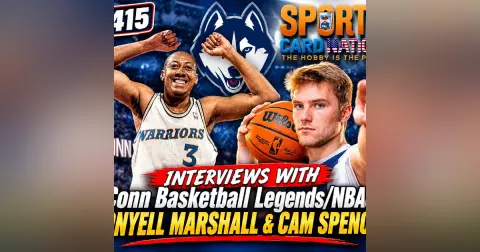
UConn Legends Donyell Marshall & Cam Spencer E415

 Apple Podcasts

 Spotify

 RSS Feed

 PocketCasts

 Overcast

 Castro
I got the opportunity to sit down with UConn Legends Donyell Marshall and Cam Spencer. Donyell has a solid 16-year NBA career and Cam's in his 3rd year with the Memphis Grizzlies. We talk basketball and hobby.
Follow us on Social Media:
Website:
https://www.sportscardnationpodcast.com
https://linktr.ee/Sportscardnation
Merch shop:
https://sports-card-nation.printify.me/products
To eliminate pre & post-roll ads
https://www.spreaker.com/podcast/sports-card-nation-podcast--4761791/support
0:00 Sports Card Nation, the hobby is the people. Weekly news and interviews, it's your number one source. Sports Card Nation, the hobby is the people. Sports Card Nation. What is up everybody? Welcome to episode 415 of Sports Card Nation. Recently, I've been very blessed to get to interview some professional athletes, past and present. A few weeks back, we had Cooper DeGena of the Eagles, pro bowler. But even before that, on September 20th, I went to the New England Card Show in Springfield, Massachusetts, and I was allowed to do some content on the floor.
0:54 And I was able to interview two, I interviewed 10 people, but I was able to interview two athletes, one retired and one still playing, NBA basketball players, starting with Donyell Marshall. Both are UConn legends, but starting with Donyell Marshall, who had a 16-year NBA career with eight teams, at one point held the most three-pointers in a game record. It was later broken. And a great guy, wound up being a college basketball coach, which he may do again, as we discussed. And after him, I was able to interview another UConn legend, Cam Spencer, who's currently in the NBA with the Memphis Grizzlies, averaging almost 11 points a game, five rebounds and five assists, and won a title in recently in 2024 with UConn. And so both great guys, great interviews, had a lot of fun talking to them.
2:01 And so those are the interviews that will air today on this special edition of sports carnation. So both will air today, no double episode, all no part two. This will be all one, one episode next, next week. I also interviewed seven or eight dealers and collectors at that show, and that show will air next week. So, you know, some content coming from the September 20th Springfield, Massachusetts show. Thanks to John DeMornay for the opportunity. He's the promoter.
2:43 I want to thank our great sponsors, SGC, Iron Sports Cards, Sports Collectors Digest, Hobby Hotline, Upper Deck, Card Ladder, and the Certified Trading Card Association. So today's episode will be, first I'll lead off with the Danielle Marshall interview, and then followed by the Cam Spencer interview. Hope you enjoy, and we appreciate all of you out there. Attention Sports Card Nation viewers. What up, kids? It's your boy Scott Hanson from NFL Red Zone. Oh, we're back. Ball is back. The hobby never ends.
3:24 And before you know it, I'm going to be on your screen again, rocking that octobox, knocking the bottom out of the witching hour, and announcing seven hours of Red Zone football. But as you watch Red Zone, just save some time. Monday, Tuesday, Wednesday, Thursday, Friday, Saturday, to check out John. and SportsCard Nation. Let's have a great season, people.
4:06 All right, this is a real honor and privilege for me here at Sports Card Nation. I have somebody joining me today that I watched play. I'm in Syracuse now, and when he was at UConn, I was in Syracuse. I'm originally from New York City. But I watched this guy do a lot of damage to our Syracuse Orangemen at the time. He's the 1994 Big East Player of the Year. NBA veteran, college coach, former college coach, coach at the G League, just all-around great basketball guy, Donyell Marshall. Welcome. Thanks for having me. So let's kind of take it back to sort of where it started college-wise with UConn. I call it the Big East heyday. I mean, it started even before that.
4:57 To me, it's not the same as it used to be, if I could be so biased, but just some memories of some of those UConn-Syracuse matchups and some of the guys that you played against in some of those battles. Well, that was always a special battle to me because a lot of people don't really know that I actually was going to commit to Syracuse. I was there in the early signing period. I was there on my recruiting visit. I was going to commit to it. My mom kind of talked me out of it. I think the longer it went, you know, the worse it probably got for Syracuse and not. Nothing that they did.
5:38 It was just more Connecticut just did a good job of, you know, convincing me to come there. So every time we played Syracuse, it was a special moment because of, you know, obviously playing them in our conference. It was a rivalry. but it was also special because I knew at one point in time, that's where I wanted to go. Um, you know, they had Billy Owens there before me. He's from Carlisle, Pennsylvania, which is about 30 miles away from where I grew up. So, you know, I always idolized him, um, in high school and, you know, I became friends with those guys, um, you know, from, from the recruiting visit. So it was always a special, uh, time every time we played them, but it was some great battles. I think every year I was there, we split, uh, one in one. So, um, it was always great battles when I was there and always great memories.
6:22 I was a coach Bayheim at that time, you know, where he almost had you and now, you know, you're as a foe, you know, as a, as a player, how, how did, you know, did you hear any kind of trash talk? Maybe not so much from, from coach Jim, but maybe players or like you should have been here or not really. No, we didn't hear anything like that. You know, everybody knows at that point in time, you mean it's, it's, goes to where you're going to be where, you know, where you fit in the best and stuff. And I don't think it hurt any of our friendships. Um, you know, they knew what it was. It was a, it was a battle. Um, and UConn came out on top at that point in time. Um, but nobody's ever, we never talked trash and was never like, you know, you wish you had me or, you know, wish you was here or anything like that. Um, like I said, even to this day, I'm still friends with most of those guys. And, um, you know, so, um, It was nothing personal like that. It was always just a friendly rivalry.
7:19 Well, I'll say I didn't know that until you mentioned it. I wish you would have came. Syracuse hindsight being 2020, just an incredible player. Your lottery pick, you go fourth, you know, and then 40 games later into your rookie season, you're traded. What is that like? Here you are, like, you know, you're riding the high of being the fourth overall pick, and then you're told, hey, we're sending you. somewhere else, kind of go back to that year. What was that like as a rookie in the NBA? It was a difficult start.
7:59 Coming in and having the preseason I had where I was averaging a good amount of points, thinking you're going to come in, thinking you're going to be named opening day starter. You weren't named opening day starter. Going through some ups and downs, got hurt, hurt my ankle. Um, missed about 10 games. Um, so it was fighting to come back from that. Um, and then just some shiesty stuff that was going on that I found out about later in life. Um, you know, that led into the reason why I was, uh, traded. Um, And, you know, nothing to get into any of that. But, you know, when when when you found out things of what led to you getting traded and then when you found out like later in life that, you know, it was one of those boomerang things or one of those karma things that came back to haunt, you know, the things that happened that led to me getting traded.
8:48 But. You live and learn, right? It's the game of basketball, the game of sports, pro sports is a business. So you go there, you want to have fun, you want to live there, live your dream. But the quicker that you can learn the business side of it and the political side, it helps with the on-court side as well. So for me, it ended up working out well because I had to learn early. And once I learned it, the trade became a shock. You know, so once that shock hit me, I knew I had to sit down and really learn everything that was going on with everything else. And I think it helped me out. I was going to ask you, Don, I think you might have just answered the question. Did you hear any rumblings or whispers that this was potentially in the works?
9:30 Or like you said, it just came out of nowhere and then you were like informed. It came out of nowhere. Honestly, I remember that day like it was yesterday. You know, was in practice. We had a good practice. Was going to play Orlando the next day. And so it was a light practice because it was I think it was like a one o'clock. game it was a one o'clock sunday game we were going to play orlando i was excited to go against Shaq I was excited to go against Penny Hardaway and the reason I remember even more was like that's the first time UConn was ranked number one in the country I was supposed to be a senior that year obviously but they were ranked number one in the country I was ready to get home from practice they were playing Villanova I get home, I turn the TV on, and we're getting blown out by Villanova. And so, like, my day was just notâ it was already not going well because I turned the TV on, UConn's getting blown out.
10:22 And then probably an hour after that game's over is when I got a call, said that we made a trade. And I was like, oh, okay, like, you know, who are we bringing in? And then they were like, oh, no, we traded you. You know, I hung the phone up in shock andâ was like, you know, let's go. So they didn't even bring you into the offices. They called you over the phone. Yeah, they called me over the phone. You know, that was, you know, cell phones weren't big then. They weren't whatever. And, you know, I remember when I got my apartment then, they were like, you know, get two lines, get a regular line, get a business line. And they was like, just give the business line to like the team and to like businesses and to your agent. That way, when you know that line rings, you know it's something important.
11:05 And I remember that line ringing, and I was like, oh, who's this? And, you know, obviously it was the GM, and that's when I got the news. Obviously, like you said, it was a shock. You didn't see it coming. Is that something that, you know, you're probably a pretty good self-motivated player anyway, but did that give you a little extra juice like to, hey, you're going to regret doing this, and I'm going to show you what you're missing? Because, like you said, it's only 40 games into your rookie year. I never really looked back on was like, you're going to regret what I'm missing. Like, you know, you can always look back and be like, this team didn't want me. And you can look back and say that this team wanted me, you know, so I really didn't care.
11:48 Like, you know, for me, it was like, you know, that's your loss. I go play for my new team and concentrate on my new team and see how I can help them out. You know, that wasn't the first time I was traded. I was traded yesterday. three more times after that. And each time it was just like, all right, let's go, you know, get your head on, let's go new team, go ahead and learn the system, get to know your new players and let's move on. Yeah, I appreciate you, you know, being candid with that. 2005, you held the record, or at least tied for the record, threes in the game, in one game with 12 later, broken years later by Clay Thompson. Against your favorite team, nonetheless, as well, the 76ers. When you get in a zone like that, like going back to even that game, did you know, like, early on, like, I'm not going to miss much tonight. Did you, you know, is it like players say when they just know they have a hot hand and they're just going to keep shooting? Was it that kind of game?
12:49 Well, that game, that team, that season, you know, Sam Mitchell was our head coach and his philosophy was he wanted to get up a hundred shots a game. Um, you know, so we went out and we pretty much was running gun and, um, Rafer Austin was our point guard, um, who was very good at ball handling, pushing the ball up the floor. Uh, no, Pelosi was our backup point guard. And for me, it was pretty much when you see them running in transition, go set the screen. And, That's what I did. And we knew that that game that the Sixers, both guys were going to go with the ball and it was throw it back. You know, I hit the first couple and it just it just kept going. It felt good. I think the difference for me, you know, being the record holder at that time or making 12 threes is the plays weren't ran for me. If you look at all these guys who have the record, you know, they were the first options. They have the ball in their hands.
13:42 They were able to shoot whenever they wanted to. For me, I had to get the ball passed to me, and I had to be open. So I think that's what makes it even a little bit more special is, you know, being the guy who they had to find me open. I was open enough times to get that many shots off to be able to hit that many shots. And like I said, you know, in the fourth quarter, I just felt like I couldn't miss anything. Yeah, the rim's pretty wide and big in those moments. And then with the record being broken, did you figure someone would come along? And how does that feel like you held it for quite a bit and then, you know, someone else breaks it? Like, is it is it bittersweet or not necessarily because you're still in the in the books, you know, for having that record?
14:24 Well, you got to realize the way the game has changed. You know, back when I made that, did that, you didn't, the teams didn't shoot a lot of threes. You know, it was broken by Steph Curry, you know, who did this, what the game is today. Analytics is, you know, layups, three-point shots, and the free throw line, right? So you're shooting way more threes today. Today than you are when you know when when i broke that record so it was only a matter of time you know the way the game has changed the way the game has evolved and as many threes are taken a day you know there was only a matter of time before that game was going to be broken. I've always said this danielle get your take on this like the old school nba that i grew up on you know i'm 53 years old You know, the bad boys, you know, Bill Limbeer, you know, Joe Dumars. A lot of, like, they played more defense, it seemed like, back then. Like, if you're going to score, you're going to pay for your shot. You know, I watched today's game. Like you said, it's a lot of shots from distance and that sort of thing. You know, do you feel like that, or is that just the natural evolution of the NBA?
15:39 Well, it's the natural evolution of the NBA, but you also have to go back and look at, you know, a lot of fans complain about the flopping. A lot of fans complain about as many fouls as there are today. And, you know, yes, we grew up when you had to have blood in order for it to be a foul. What you have to understand is why is it. Why is today's game the way it is? You know, I forget what year it was, but the NBA did a poll and they asked the fans, what would they like to see more? And they wanted more scoring. Right. So what how do you get more scoring? You call more fouls, get to the free throw line. You open the game up more and things like that. So this is what the fans asked for, you know, and the NBA gave it to them. And now, you know, everybody's saying, oh, it's not the same basketball. You know, it isn't the same, but this is what the fans asked for.
16:26 You know, you also coached in college, and, you know, today we have the NIL. That wasn't a thing during your playing days at college. Do you ever, like, think, like, man, I wish I played, you know, like the NIL existed the way we know it today then? Or is it something like it's just, you know, I wasn't born that year? You know, how do you look at today's college game What did the name, image, and likeness? I mean, I think you look at... It goes down from eternity, right? You go back and say, you know, Magic Johnson, Michael Jordan, all them probably wish they were born when I came out, right? I had a really big rookie deal.
17:10 You know, I was making a lot of money right away. I was making more than Magic Johnson and Michael Jordan and those guys when they played, right? So every. generation you're going to say oh i was born too soon or whatever i was born when i was born you know yes my game was probably comparable for today or whatever but then i also feel like you know for me this is me personally i'm not taking no shots at anybody else this is me personally i felt like me because i didn't have the nil because i didn't have whatever it made me work hard it made me want to get to the nba to make my future to to to you know be able to have my legacy i think These kids now, they're making a lot of money early. Yes, if you invest it right, you can make a lot of money, but you have kids staying in college five, six years making money that, yes, a lot of them are not going to make this money when they get to the NBA, but it also is...
18:02 you know, are you going to still have the same hunger to get to the NBA, right? You're coming in, you're making three, four million dollars in college, you know, you know you're not going to make that in the NBA, so are you going to have that hunger? You know, whereas, you know, I feel like for me and guys our era, like, you know, you didn't. Have that, right? So you had to go in there, you had to try to bust your ass to get into the gym and try to make your, you lived your dream out, you know? So I think it's, it is good for the kids today. They deserve it, but it also, you know, I think it helped hurts the NBA. It helps the game hurts the game a little bit. You know, you have all this, I don't even know who plays on what college teams hardly anymore because all the transferring and stuff like that.
18:42 It is crazy. The guys are playing for three or four colleges and, and it's sometimes, like you said, it's hard to keep track and, And that sort of thing. Do you think there'll be a return to coaching for you at some point, maybe? I'm always keeping track of seeing what jobs are open. And, you know, if it's a good fit, I always try to reach out. You know, unfortunately, I haven't had any luck right now. But, you know, I'm always there. I'm always open. You know, I still love the game of basketball. I still love to give back. I still love to teach. You know, so if there's ever an opportunity and the right opportunity comes, I definitely would take a look at it and make sure it's a good fit for both. If you went back to the last question here, I appreciate your time. If you did go back to the college level, which you've coached at before now, but now it would be potentially with the NIL, would your approach fundamentally be the same and you would let the people that are in charge of that do what they do?
19:47 Would you have to change with the current landscape? You always have to change. You have to change with the current landscape. The guys that are going to be in this game for a long time as coaches, you've got to be able to change. You got to be able to evolve. Um, you know, yes, you're going to have some people who are stubborn and, you know, don't want to, but then they're the ones that are not going to succeed. Right. You have to be able to. Whatever, but you know, I obviously think, you know, for me, yes, leave the, let the, let the guys who. Can handle that, you know, handle that. And I'll come in and I'll help you develop, you know, mentally, uh, physically on the court, you know, and whatever, and get you the best way possible. If you need me to help. With the NIL, as far as going out, you know, telling these guys what's good for them whatever i'll do that but you know obviously you have guys the teams now have general managers to do that right you let them handle that and then you know i'll handle the stuff that needs to be handled it's.
20:37 Even crazy hearing that right gms at college right that was always uh an nba or a pro thing and here we now have general managers that at college and football as well and the other sport. Yeah, it's definitely crazy. I mean, you have all kinds of titles now in college, in sports, anything. I think people just make up titles just to be able to get more people on staff. But, I mean, it's a good thing, right? You get people more jobs and stuff. And so it benefits everybody. Well, I'm hoping to see a return to the floor of I love it. Listen, come home again, back, come to Syracuse, whether it be as an assistant or, you know, we're obviously rooting for GMAC, but if something doesn't work out, maybe you'll get to wear the, the orange and white after.
21:28 Hey, you never know. Thank you, sir. Thank you. You are listening to the sports card nation podcast. We'll be right back after this break. I'll be hotline. Is the hobby's only live interactive call-in show. Join some of your favorite hobby personalities every Saturday, 11 a.m. Eastern, 8 a.m. Pacific, to discuss the hottest hobby topics. If you miss us live, catch us after the fact on all major podcast platforms. Follow us on socials at Hobby Hotline. We are back.
22:10 All right. Our next interview here is with Cam Spencer of the Memphis Grizzlies and a great guy. He wound up hanging with me after the interview actually concluded for another 10, 15 minutes just at my tables and just chatted it up, life and sports and, you know, who knows what, you know, anything. So really down to earth guy, very impressed with the person he is. So Here is the interview that we recorded right after Danielle Marshall's. So here's Cam Spencer of the Memphis Grizzlies. All right. Real happy to be joined by my next guest here on Sports Car Nation. He is a UConn legend, a national champion, and an NBA player now. Mr. Cam Spencer, welcome.
23:02 Appreciate it, man. Thanks for having me on. One of the things I wanted to ask you about is because I've never got to ask this of someone, you know, in 2020 COVID hit and that obviously affected everything, including sports. Talk about that. You did play, right? But then everything kind of stopped. You know, I imagine that's the first time anything like that's happened in your athletic career. just talk about that process and the difficulties to, you know, you're doing something you love and then now you can't. Yeah. It was a weird time, man. I mean, it feels like a lifetime ago. Um, we had ended our season already. So we weren't one of those teams that, um, you know, had a good regular season and, you know, we're going into the playoffs or March madness. Um, You know, and we're waiting to see kind of, you know, where we would get seated or whatever.
23:54 We had already finished our season. And then my brother, I was watching my brother play. And I think the next day after that, that's when COVID hit and everybody kind of got sent home. Just a weird time. And from there, you know, with our coaching staff, I was at Loyola Maryland at the time. We were figuring out, you. Know, when we were going to get to go practice again and when we'd get on campus for the next time. It's just a weird year, but obviously ended up giving everyone in college at the time an extra year of eligibility, which thankfully they did because that, you know, when I ended up at Connecticut for the fifth year. And love it here in Connecticut. So that was just a weird time.
24:34 Yeah, I think Connecticut loves you as well, Cam. Talk about... You know, there's a lot of legacy built up and coming to UConn and then adding to that yourself with your own national championship. Is that something as a player, I'm sure you're aware of it, but is there a pressure that comes along with that or not necessarily? Yeah, I mean, I wouldn't see it as pressure. Kind of more of an opportunity. You know, obviously I came after they had won the championship And, you know, I wanted to just build off of that. I guess you could call it pressure or whatnot or expectation. But as a competitor, man, I have the highest standards for myself as a player. And I wanted to go to go be a part of something special. And, you know, when I met Coach Early for the first time and the staff and got on campus, it was it was really a no brainer. Match made in heaven and just super grateful for my time at Connecticut. I wouldn't be where I am today without him. coach early and and uh connecticut.
25:41 Is uh you know we see coach you know on tv and he gets crazy but no one can deny he's a great coach like what we're seeing that like on on tv what's he like what you can say like even what we don't see. Yeah i'd That's always funny when people ask because I think he's calmer. And what you see on game day, he tends to be calmer than he actually is in practice, which is funny to say because he's still pretty wild during games. But no, man, that's what I appreciated about him. The intensity that he brought every day and the care factor for wanting to win and hating to lose. He gave everything to his team as a player. You just wanted to return that favor and didn't want to let him down. You just want to give him everything that you had. And, you know, that's why he's such a great coach and just a great leader of men.
26:34 Yeah, well said. You know, I had Danielle Marshall on earlier, another UConn legend who didn't. You know, he didn't play during the NL. There was no NIL when he played. I got him to weigh in on that. For you, like, what are your thoughts? Do you likeâ now you're in the pros, but do you like the system that's in place? Does it need to be tweaked? I know there's people on both sides of the aisle, someone who's went through it, so to speak. Like, you know, can it be improved upon? Does it need to be improved upon, or is it good in your opinion? I don't lean one way or the other too much, you know.
27:17 I'm obviously very happy for the players who get to benefit from all the revenue that college basketball generates. I think for a long time, athletes weren't able to benefit from that. So I think it's in a good spot there. Guys are making very good money at a young age, which is great. Now, I think the trade-off is you see a lot of movement, especially where the transfer portal is. Year to year, you're kind of like a free agent after each year. And I feel for the coaches there. who have to go re-recruit their own players, recruit from the transfer portal, recruit kids from high school who I think probably are the ones that are, you know, getting hurt the most because it's such a win-now business. And, you know, coaches don't have as much time to develop high school players unless they're going to be, you know, maybe a one-and-done. They're not really recruiting those kids as much.
28:06 So I think that impacts them in a negative way. But, again, they're a tradeoff. Guys are benefiting fromâ you know, the financial side of things with NIL, but there could probably be some changes that would help it as well. Yeah, good point. You made, Cam, like what coaches, right? It makes their job easier. which is probably hard to begin with and maybe even a little bit harder. I think we've seen some coaches leave the business on the college level, even maybe more so on the football side of things. I've heard a couple of them say, this isn't what I want to do now, like under these. They were also older and kind of, you know, they're used to a certain way. But, you know, you made some great points with how it has, you know, changed the landscape. So you're drafted 53rd by Detroit. So it's draft night, you're picked, and then you're traded on draft night to Memphis.
29:06 Yeah. Did you know, was that a surprise? Did you know that was in the works? Talk about, like you're still in the pros, it's still a great night, but you're in one city, then you're in another. Talk about that day. Okay. Yeah. Um, so I actually, when I got drafted by Detroit, I was talking with my agent. I knew that it was going to be traded to Memphis. Um, I don't, I think on TV, it doesn't come up right away. Uh, but I, I knew that I was going to Memphis, um, even though Detroit drafted me. Um, and I had, I had great talks and relationships with, you know, that climate and, and the organization beforehand. So I really love what they represented, you know, a blue-collar organization. Had guys like Ja, Dez, Jaron, guys who were, you know, building the culture there. And I was really happy to be a part of it and still am. And, you know, obviously those guys aren't with us anymore, but I just love theâ Again, the blue-collar nature of Memphis, the city, and the organization itself.
30:03 And I think we're going to surprise some. People this year. Yeah. And like you said, you kind of knew that was in the works. That probably beats the alternative, right, where you didn't know and, like, here you find out. But you kind of knew that was coming. Talk about the transition from the college game to the NBA. Obviously, it'sâ It's probably faster. It's different. But was it kind of what you anticipated? You know, you're talented in your own right. But talk about going from the college to the pro ranks. Yeah, we're actually just talking about it. But first off, I was lucky to have my brother who is four years older than me. I wouldn't be here today without him. You know, so I was able to watch his journey in the professional level in the NBA.
30:51 And he would, you know, give me tips on kind of how the game is different. But then once you get there, I'd say the two things that are most noticeable are, you know, the 24 second shot clock compared to 30. That's like a lifetime in basketball. You know, I don't think people think too much about it, but you just don't have as much time to run a lot of actions. You know, it's more like great spacing and a lot of pick and roll. And a lot of great playmakers, obviously, because the talent is so special. And then the other thing would be the three-point line being a foot. And a half longer. It just makes closeouts harder. It makes, again, more spacing with better players. It makes it tougher. So I'd say those two things are the biggest difference. Yeah, yeah, I get it. And six seconds doesn't sound like a lot, but it's one-fourth of the shot clock that you're used to. that's gone now so yeah for sure um you mentioned you i was going to ask you about this you mentioned uh your older brother who's in phoenix yeah um you know do you have that sibling rivalry where i know he's your older brother and he probably tells you he's better than you just because he's older yeah and you're like with that age doesn't mean nothing i'm still more do you have those sort of even tongue-in-cheek just funny things like that We do.
32:05 I mean, we're so competitive, but we're each other's biggest supporters. You know, if I'm not playing, you know, we were just talking the other night about, you know, looking forward to getting the game back and running because, you know, I'm either playing one night or I'm watching his game the next. again yeah we have the obviously the competitor in us that want to be better than the other one but to be honest we root for each other more than anything um so we we you know there are definitely a lot of fights on the court though growing up yeah. A little trash talking amongst brothers a. Lot of trash talk we have a younger brother as well uh two competitive parents so that's the thing is like growing up you wanted to win so badly cause you didn't want to have to hear the other one, you know, talking trash.
32:48 And letting you know about exactly. Yeah. So that made, that incentivized you to win even more. But again, just family that loves each other and want nothing but the best for one another. Yeah. That's awesome. I I'll kind of close with this too. I think you alluded to it already. Cam, like how, like how much of a help being Pat was, you know, in the league to help you, you know, obviously a brother is going to help your brother out, but just talk about what he's meant to you in that transition. So much, man. Both on and off the court, like just such a great role model for me, you know, works hard, has fought through adversity his whole life.
33:30 And just, again, being four years old, he's, you know, four years younger. I am to him. I was able to learn from his high school experience, his college experience, you know, and then, start my journey on those, you know, on that four year path. And, you know, again, going back to the, his experience in the NBA and being able to pass down a lot of knowledge for me and what he's seen and what he's had to deal with, you know, has been instrumental in my success and just my life in general. So I wouldn't be here without him and super grateful for him. We're ready to get the season started and have a good year. I'll actually close on this. Does he ever say that? Like, whatever good happens to you, you got me to thank for because I went ahead first. He did not.
34:13 I mean, he's a humble guy. He doesn't have to say it. I'll say it for him because that's how special he's been to me. And again, yeah, just show me all the right things to do, and I'll never stop looking up to him. Yeah, that's awesome to hear, Cam. And wishing you continued success as your NBA career progresses along with, I know he's not here, but with Pat as well. Thank you, man. I appreciate you having me on. Yeah, thank you for making the time. Thank you. Yeah, appreciate you. All right. You know, as we approach Thanksgiving here, I just want to reiterate, you know, that how blessed I am, right, to get to do some of the things I do, including, You know, talking with professional athletes, especially in recent months here with, you know, Cooper DeGene and Daniel Marshall and Cam Spencer, you just heard. And even in the past, right, with actors and other athletes, I've gotten to talk to.
35:16 And the collectors that appeared on the show, the CEO, everyone that's appeared on the show from it. from a six-year-old kid to an 80-year-old man. And very blessed that I get to do this. I enjoy it. It is a passion project. It's a labor of love. All the cliches, but they're true. And not a day goes by that I don't think about that. And also, blessed to have a great listener base and sponsors that make the show possible. And I just want to thank everyone as a whole, right? This is just very cool for me. I don't take it lightly. I don't, you know, take it for granted. And, you know, thank you out there. Thank you to every guest that's appeared on the show. Thank you to all the sponsors. And thank you, probably most importantly, thank you out there who are listening to the show and make it possible to keep doing it. So with that being said, we're going to have some our Hobbies of People announcer of the week, and wrap up this week's episode. Let me know what you think. We're always open to feedback.
36:26 And also when it comes to the Hobbies of People, if you want to be part of the show, listen to that, what you need to do. Love to have, whether you're a content creator or just a listener, you're more than welcome to be part of the show. So thanks, everybody. Time for our Hobby is the People announcer of the week. This is Ed Johnson from Toronto in Canada, collector of Vladdy Jr., Blue Jays, Roberto Clemente, and Willie Mays. Never forget, the hobby is the people. Like to be the Hobby is the People announcer of the week? Do a WAV or MP3 file and send it to sportscardnationpc at gmail.com.


