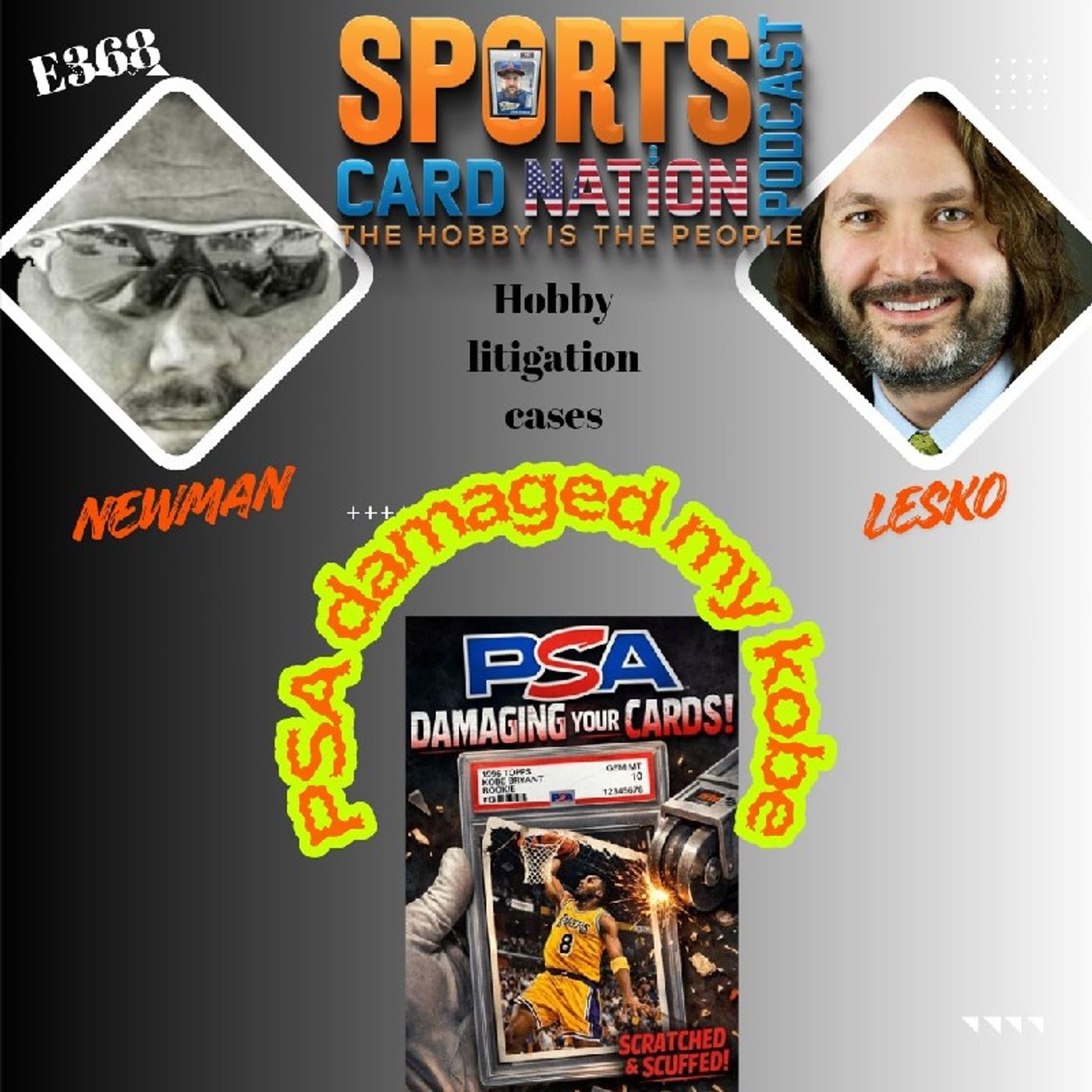
"PSA damaged my Kobe?" w/ "The Hobby Lawyer" Paul Lesko E368

 Apple Podcasts

 Spotify

 RSS Feed

 PocketCasts

 Overcast

 Castro
"The Hobby Lawyer" Paul Lesko is back.
Today's Hobby Court Case:
"PSA damaged my Kobe Bryant Refractor"
Paul joins us to discuss some interesting hobby related court cases.
Follow us on Social Media:
Website:
https://www.sportscardnationpo....com
https://linktr.ee/Sportscardna...
Merch shop:
https://sports-card-nation.pri...
To eliminate pre & post-roll ads
https://www.spreaker.com/podca...
0:00 Sports Guard Nations, Hobbies, the People, Wheely News and Interviews. It's your number one song. Sportscarnation. Hobby is the people sports Guarnation? What is up? Everybody? Welcome to episode three sixty eight Sports Cardination. We have Paul Lasco, Part two of four. If you didn't catch last week's show about a grading card company losing an ONUS Wagner card, go catch that today. How about PSA damaged my card? If you're integrating, it's probably not you've probably heard that before, hopefully it's never happened to you. But today's show, I was going to talk about a legal case involving a damaged Kobe Bryant card.
0:57 Any value loss based on the damaged and the plaintiff is a legend at PSA damaged a refractor card of Kobe from the condition he sent it in, and he wants to be compensated. And this case would be precedenting setting if the plaintiff winds. Because I think we've all heard at least once somebody claim that their card was damaged. I don't want to just pick on PSA, but by a grading card company. Heck, I'll be honest with you, I do the bolk shopping for SGC, and I've had not someone definitely saying, but just sort of questioning, like I didn't notice that when I sent it in, although I send in the cards that they they give me.
1:51 And after that, you know, we're at the mercy of the grading card companies doing the right thing. So very interesting case on today's program, and I think you'll enjoy it. As always, wanted to thank my sponsors, Iron Sports Card, rober Lent. They doing a great job there. Sports Collectors Digest, the longest hobby publication and I get the right for them Hobby Hotline, our Saturday Morning Conglomerate show and Upper Deck. So thank those guys. And with that being said, let's get this show. And Paul asked Paul LESCo back on for part two. All right, here is part two of our conversation with Paul Lesko, and we're gonna be talking about a court case where PSA allegedly has damaged a Kobe Bryant car. So here we go, PSA, you know, damaging a card somewhere in the degrading process in their possession of the car. And I've heard people without even going to litigation, I'm sure you have to see people go on social media and say, look what PSA did to my card, or that's not the condition I sent it to him in and here is how I got it back. You know. Talk. But when it comes to a court case, let's let's tackle it.
3:16 Yeah. And I think that's you know, the cases that interest me the most. Like while we can't relate to you know, Beckett losing our T two o six on his Wagner, we have heard about it. We've heard about people, you know, I sent it a card, they sent it out on un FedEx. It never arrived. You know, we've all heard stories like that. So, Adam minimum, you can relate to it at a basic level. But this one I think people can relate to more so. And this is a case that has been going on for four or five years. So it has to do with a nineteen ninety six Kobe Bryant chrome Rookie refractor from from Tops and the card was sent in by the plaintiff to PSA.
3:59 And and when the. Card came back, I think it came back as if there was a what he called like a dent or a divot in the card. And he's had pictures from beforehand he submitted. You know, he's got pictures from right when he handed him in, he's got pictures from afterwards, and you can see there's something going on with the card. There's something that was there that wasn't there beforehand. So his allegation, he's alleging that, hey, this card should have been a ten and you know, maybe nine, but it probably should have been a ten because you've damaged a card you slabbed it as an eight, that I've lost significant value, and especially when you're looking at a case from four years ago, five years ago, twenty twenty. Was the boom time. It was a boom time for card.
4:40 So there are you know, I think I don't remember the exact value he's looking for, but it was, you know, several hundred thousand dollars. He believes he has been damaged from the card going from a ten to an eight. So this case has been going on for ever, and finally we had a trial in the end of November. Early no, it was the beginning of the beginning of November. We actually had a trial in this but the trial was in a state court and the docket does not update very well, so. We don't know what happened. We don't know the result. We know that there were three days a trial. They were in the plaintiff rested after day three, and then it was time for the defense case. And we don't know if the defense put on a case. We don't know what happened, and it's it's really frustrating because this is one of those cases where, like we talked about what is the value of the card? Well, first of all, what is the obligation of a grading company if they damage the You know, that's what's important about this case.
5:36 It'll help decide that. But the other thing is what's the value of the card? Are we valuing this card when he submitted it? Are we valuing the card today because it's had you know, that card's probably had a hundred, one hundred and eighty thousand dollars swing in value. Because the case is long, so it's it's a really interesting case. But it also had a funny side issue where the plaintiff never cracked the slab. And that's one of those things where if I have cases that involved trading cards, especially if it's against the grading company, I want the card in the slab, you know, I want to be able to show well to. Me not to cut you up. Puff he cracks it out of the slab, he kind of he doesn't have a case really well because he.
6:19 If he cracks it. So the plan, so part of the defense that PSA said was, hey, it's not damage to the card. It's just some like dust or something that's stuck in there. So if you just crack it out, the dust will go away and you'll see your card is perfect now. So he included some close up shots and it really looks like it's the actual damage to the card because the chrome layer, it looks like the chrome layers rubbed off and you could actually see the cardboard. But he's his position was his lawyer's position was this defense that it's just something stuck in the case is ridiculous. So we never wanted to crack the card, but get ready for trial, and that's what a PSA is defensive. So the plaintiffs, well, you know what, if I want, I can crack the card on the stand and let the jury see what's going to happen here.
7:06 So if you're going to put. Forward that defence, we're going to crack the card on the stand, to which PSA brought a motion saying no, you can't. You cannot crack. The card because if you were going to crack the card, you needed to do it while this case was running for four years, so that we could have experts in the room to make sure you're cracking the card correctly, and then afterwards we can have our experts look at it. You know, you can't just crack it on the stand because crazy things can happen. And that's one of the things I want to see what was going to happen in this because the judge was, look, he hadn't totally ruled on this yet, but it looked like he was more of a let's maintain the status. If you haven't cracked the card up till now, you probably shouldn't crack it during the case unless something weird happens.
7:48 So now we don't know what the card was cracked or not. And that's something that I really want to see because it's funny where someone's willing to crack their card and the other side saying no, no, no, no, don't crack it out of the case. But so in this case, maybe so this case may be resolved, and you just don't know how it was resolved. It could be And that's what's frustrating because the last day that we have like a transcript, not transcript, but we have minute order for the court explaining what happened during trial is from November fifth, So we are over a month since the third day of trial and we've had no updates from the court on it. So we don't know. Somebody could have won. I mean, this case could be over and we just don't know. So it's somewhat frustrated.
8:29 How do you find out or there's not necessarily a full proof way. Are like attorneys, Like if you knew the attorneys in the case, could you, as an attorney, say, hey, what happened with your case? How does that work? They are? They not allowed to speak until the result. They are And I am familiar with the lawyers at least on one side of this case, and I'm familiar with the experts that were utilizing these two. However, when it comes to how I cover cases, I only cover what on the dockets. I only cover what the parties have filed. Because when you're filing something with the court, you have to do it under for like federal court, you have to do it under what's called rule eleven, meaning you are basically swearing under penalty of perjury that everything you're saying is true. So because of that, I only go by what's on the court docket, because somebody is swearing that everything in there is true. Now, sure they may be pushing it a little bit, but that's what the other side is there to push back for. So I really don't like to talk to people outside of the cases and get their opinions on it.
9:32 Now. I figure for this, you're right, I should probably just reach out to somebody and say, hey, is it over? Is it still going on? But I keep hoping that the court website will just update and tell them, because that's how I mean. We're in twenty twenty five. Federal courts right now are beautiful. They update daily. You can if you have access to the PACER system, you can see what's going on in any case federally, all across the United States, all fifty states, whenever you want. Problem is, this is in a state, and some state courts have very good dockets. Some state courts have abysmal dockets. Some state courts, like this one, have dockets where you have to pay money to actually see what's going on. So this is one of those dockets that I think it's a little bit backwards.
10:14 It costs money, and you just really. Never know what's going on. Yeah, So that was a long way of saying, there's a way to figure it out. If it was in a better court, we would know, But it's in a court that's difficult to understand what's going on there. So I just don't know what's happened. Time to hear from one of our great sponsors, but Sports Guardination will be right back after that. Hobby Hotline is the Hobby's only live, interactive call in show. Join some of your favorite hobby personalities every Saturday eleven am Eastern eight am Pacific. To discuss the hottest hobby topics. If you miss us live, catch us after the fact on all major podcasts platforms. Follow us on socials at Hobby Hotline.
11:01 Let's Go. You are listening to the Sports Card Nation podcast. Let me ask you this I again, and I could be like completely wrong here. I would think if the plaintiff won the case, we he'd probably go to the mountaintop and scream like I beat PSA. You know, don't let them like ruin your cards or you know, take and again maybe he did that and we haven't seen it or I haven't, you know, but the fact that neither one of us knowingly has seen something like that, can we can we kind of make the assumption at p s A one or or you really can't. You really can't because most cases settle with a confidentiality agreement.
11:45 And so you know, if the case went to the jury, I think you're probably right. If the case went to the jury, or if the judge determined it however was going to be determined. I think whoever won would have been touting their win, you know, would have been said, hey, we won this case. We shut it down. You know. So maybe it hasn't been decided yet, maybe it's been put on hold, or maybe the parties settled it. And then that could be why the docket's not updating, because the judge is like moved on to other things. He's like, I don't need to update a docket for a case it's already resolved. It's just we just don't know. It's it's frustrated. And that's like PS. They settled with the plaintiff, right part of that settlement, can be like, you don't just the cas is over, we're paying you such and such, don't discuss the case anymore. It's exact, almost like a gag order.
12:30 Yeah. Basically the language you know that we typically see for settlement agreements like that is the if you're asked about this case, you know, both sides agree that they could say that the parties settled it amicably. That's like all you can ever say about. Then you just have to look. You just have to look at whoever says it, whichever lawyer says it, or whichever side says it. How big are they smiling, you know, smiling ear to ear? Maybe they want are they kind of frowning when they say that maybe they lost? No, I if this case settles, If it settles, I guarantee they'll be confidentiality. That's why I really hope it goes all the way, a final judgment. Without knowing, without knowing, and putting on like your lawyer cap, your judge cap, how do you think if it did end?
13:13 And they're like, how do you think it ended? If you're you know, it's like predicting the score of a football game based on the teams and the strength and you know, how do you think it may have ended. I think from looking at the card from what I've in the exhibits, I believe there was damage shard. I believe it looks like some of the chrome has been rubbed off. I think you get the cardboard, so I think there's a good chance that it was found that the card was Then you turned the liability to the damages to the to the dollar value that the plaintiffs should get paid. And that's where I have no idea, and that's really why I've been watching It is just gonna be a three hundred thousand dollars payment, is going to be a sixteen thousand That's really something I'm looking forward to saying.
13:54 And really, for a case that's been going on for. Four or five years, no matter how much gets paid or if there's a zero involved in the case, it doesn't seem that it was worth everybody's time. Well, I think the only winner in this case is the defense attorneys that were probably getting paid on an hourly basis. They've probably done well in this case. But I imagine the planktiff's attorneys probably took this on a contingency and I just can't imagine anybody's coming out other than the defense attorneys, which my hats off to him. Yeah, I was gonna ask you, like, if I'm the gentleman who's this is his Kobe Bryant, and let's say he doesn't win the case, does he lose on top of that because he has to pay his lawyers and court fees? Like, how does that? I mean every case is different, but generally speaking, how does that work? Like?
14:42 Go ahead, Yeah, so most of yeah, most of the h Since the US system typically is each side pays their own lawyer, so unless unless the case is found to be a agreed if it's egregious, then you. May have to pay the other side's lawyer. Court costs, however, typically the loser pays court costs, though really aren't anywhere near you know there, you know, court costs would be a filing, you know, deposition costs, you know, and it really would just be like standard transcription costs, not even like travel or hotels are you know. Typically that's that's about the extent. If the case goes all the way and there's a judgment, well then somebody has to pay. If the case is egregious, you may have to pay the other sides attorneys fees.
15:23 But when it comes to paying your own attorneys, if this case was taken as a contingent fee basis for the plaintiff, he normally won't have to pay any attorneys because plaintiffs in that case, the plaintiff's atorneys in that case, would only get paid if there was a positive result, if there was a settlement, or if there was a judgment. So yeah, I mean, if the plaintiff does not win, I imagine their attorneys took the case on a contingency and they're getting a big zero for the case. So they rolled the dice and crapped out exactly. Yeah, And that's the type of litigation I do. I'm mainly a plaintiff's attorney, so you always make sure when you have a case like that comes in, it better be a winner. And not only had it better be a winner, there better be enough damages involved that you get paid.
16:09 So like with some of my artist cases, you. Know a lot of the people that are knocking off artists that are out there, they're artists. Also, they don't have much money. So if they've caused say one hundred thousand dollars two hundred thousand dollars worth of harm, but they only have three dollars in their bank account. It's not a good case to take out a contingence. And that's why I always have to tell my clients where not only do you have to have a bad guy on the other side who did something wrong, you kind of have to have a bad guy with money who did something wrong. Because if they're broke, all we can do is shut them down. We're not getting money out, all right. I kept this episode a little shorter than normal with the holiday season, but we'll be back next week again with Paul. We got some more cases on the docket, actually a full docket. We'll be talking about next week.
16:57 Lor Kana versus Upper Deck, some of the twist and turns there, Panini versus Fanatics, and then Wildcard versus Panini, and those are obviously two separate cases, but Paul's going to explain to us why even other are two separate cases. One may have an effect on the other. So part three of our four part series will continue next week with Paul. What I like about doing it this way, They're not chronological, so if you miss one, you can go back, you can you don't have to listen to him in order. And again you know this. These the cases have an impact on the hobby in some sort of facet. So as always we appreciate Paul sharing his insight and knowledge as as an attorney. So we'll see you here in a week. Happy Holidays, Happy New Year, and we'll be back in a week. Let's hear from a Hobby's the p people announcer of the week and wrap up this week's short episode.
18:05 Time for our hobby is the People Announcer of the week, Yo, and hello Ruddy. Might hear Baseball Collector and remember that the hobby is the people. If you'd like to be the hobby is the People announcer of the week, do a one or MP three file and send it to Sportscard Nation PC at gmail dot com.


